









Administration
Maximize website design with proven techniques to improve your online showcase.

Overview
December 1, 2025
There are technical and artistic aspects of an online business that I detail below in five components.
While it’s common to become overwhelmed with creating and sustaining a successful website, this article provides insight about how to examine essential components to then be able to break the work load into manageable next steps.
The success level of your online business presence begins with your website build. It is sustained with SEO that’s applied to your media, which is also used in online marketing.
You will always have reliable metrics to create a road map for your next move by understanding business intelligence that involves comparing your online business with your competitors.
These four statistics provided by SEMrush demonstrate the importance of website administration:
A. 93% of online experiences start with a search engine.
B. 75% of users don't go past the first page of search results.
C. The top Google result gets nearly 40% of clicks; featured snippets get over 40%.
D. SEO drives significantly more traffic (1,000%+) than organic social media.
Above all else, you want your website to be composed in such a way that your business stands out from your competition.

An important aspect, sometimes overlooked, are installing analytics software from day one on your website. Google provides this for free. No matter what software platform you use to build your website, be sure to install Google Analytics so you can use it to monitor real-time results, as well as a roadmap of what you need to improve.
One technical aspect I see most of the time that’s neglected or underused is meta tags on all the web pages. There are three types of tags you want to optimize and keep current: title tag, page description tag, and browser title tag.
On the artistic side, your website design must have intuitive navigation, use a page layout that is pleasing to the eye, and the content must load quickly. The images you use must illustrate your claims and support your business objectives. Don’t forget to add the image description of the image.
“Websites with blogs generate significantly more leads and inbound links, with posts including images and videos seeing huge boosts in views and traffic.” - Google AI

SEO has several aspects including how you construct your website and media and how you distribute your content.
Most importantly, your successful SEO will translate into continuous improvement of engagement by website visitors at your website.
One significant key indicator of SEO success is the number of high quality backlinks into your website. By this I mean website links that have a Domino Authority of 50 or higher. The Domain Authority scale is zero to 100. Zero means you are invisible. A few examples of sites with a score ranking in the 90’s are Google, YouTube, Ahrefs, and Moz.
The first thought that comes to mind about media is pictures, photos, and videos. Verbiage on your website and in your online marketing is also media.

There are also additional types of media such as an online library, product catalogues, audio recordings, including podcasts, or translating your website into another language, such as Spanish.
There is always the question, “Is AI or human content more effective for my website design and online marketing?”
I believe, and have the experience with results, that human content is more effective. Below are the current statistics produced by AI when I asked that question.
Creativity & Originality: Humans generate truly novel ideas and unique perspectives; AI often remixes existing data, creating derivative or formulaic content.
Emotional Intelligence: Human writing carries genuine empathy and connection; AI can mimic emotion but often feels flat or lacks deep feeling.
Critical Thinking: Humans provide nuanced analysis and draw on experience; AI struggles with deep, critical thought and may introduce factual errors or context issues.
Style & Voice: Human writing has a distinct, natural voice; AI can sound robotic, formulaic, or overly perfect, though this is improving.
Speed & Scale: AI generates vast amounts of content rapidly and consistently, ideal for data-heavy tasks, while humans are slower but more adaptable
“The average time spent on a web pages is 54 seconds. Understanding the amount of time spent on-page can help inform website design, content creation and other strategies aimed at improving the user experience.” Forbes

The easiest way to think about online marketing is content distribution, aka content marketing.
Online marketing is both artistic and technical. The artistic aspect is engagement. The technical aspect includes engagement, but also fulfilling current search tech requirements. For example, one important variable in search algorithms is content freshness. An important variable in search algorithms is content freshness.
The websites that are ahead of their competition continuously produce media that is distributed by their outlets. An outlet can be your blog or social media channels, and a more advanced technique is implementing an RSS, Really Simple Syndication, feed.
The key to improving visitor traffic to your website is placing your media in locations where your potential customers frequently visit. In other words, target platforms that your potential customers visit. A proven strategy is using blogging to answer how-to questions along with content that displays what you preform or provide.
Media development, when done correctly, will build your content to be integrated in results provided by AI such as ChatGPT, Perplexity, and Google AI. This effort requires deep content to demonstrate your business as a leader among your competitors. This level of content will also contribute to producing more backlinks, which in turns supports boosting your Domain Authority.
The data that compares you with your competitors is business intelligence.

For example, when you see real-time results, specific to your business, that use words and phrases determined by current search trends, how many organic listings display your website on the first page of search results (FPSR).
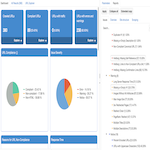
The other type of business intelligence is examining website diagnostic reports on your website, along with your competitors. This report lays out in black and white the website strategy of your competition, which includes thier SEO.
The standard metrics of any website administration are to elevate these elements on a website:
- Traffic & Behavior: Unique Visitors, Sessions, Pageviews, Average Session Duration, Pages per Session, Traffic Sources (Organic, Social, Direct).
2, User Experience: Page Load Time (users expect < 2s), Bounce Rate (leaving after one page), Exit Pages, Mobile vs. Desktop usage.
Performance & Credibility: First Impressions (design matters!), User Experience (bad UX loses customers), Website Reliability.
Conversions: Conversion Rate (e.g., purchases, sign-ups), Leads Generated, Goal Completions
Summary
Successful website administration will not occur overnight. It’s a continuing process that relies on your investment to achieve effective website administration.
It’s easy to become overwhelmed with keeping your website on track to elevate your online presence. As you chunk it into segments, which I have outlined above, you gain clarity on how what you have and the steps necessary to improve your website performance.
